

Why hire a coach? How a coach compares to a mentor, consultant, and therapist
If you've never worked with a coach before, you might be wondering: do I really need one? Can't I just talk to a mentor — or a therapist — or AI? Great questions. Here's what's actually different.
You're not short on information. You're short on clarity and direction.
Most people who reach out to me as for coaching know that something needs to change. Things aren’t working for them and they're still unclear on what exactly they want to do, or they're don't know how to reach their goals.
What they're missing is the structure, the honest reflection, and the accountability to move forward.
That's the gap a coach fills.
But to understand why coaching is different, it helps to see how it stacks up against the other options.
The key differences: Coach vs. Mentor vs. Consultant vs. Therapist
Here's a simple breakdown:
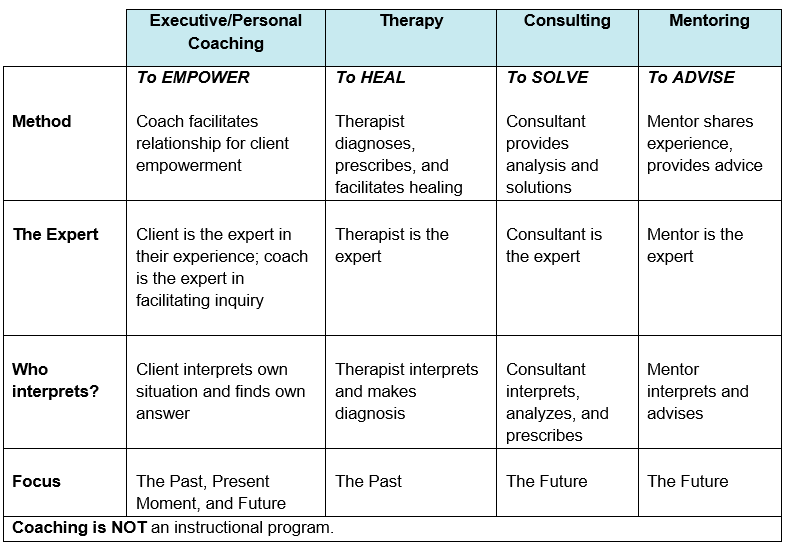
The biggest difference? In coaching, you are the expert on your own life.
A coach doesn't hand you a plan. They ask the questions that help you build one yourself — one that's grounded in your values, your goals, and your real life. This way, you truly are following your own instincts and are not dependent on someone else to tell you what to do.
When do you need a mentor?
If you want advice, you want a mentor — not a coach.
A mentor shares their experience. They've been where you want to go, and they can tell you what worked for them. That can be genuinely useful, especially early in your career, when you're still building your foundation.
But here's the thing: the more experienced you are, the less useful a mentor becomes. Once you have your own track record, someone else's experience starts to fit less and less. Your career path, your industry, your strengths — they don't look exactly like anyone else's.
Coaching, on the other hand, gets more valuable as you grow. The bigger your decisions, the more it matters that you trust yourself to make them well.
What about a consultant or therapist?
A consultant is brought in to analyze a situation and prescribe solutions. They are the expert. You implement their recommendations. This works great for technical problems — legal questions, financial modeling, or an operational process that needs fixing.
But your career? Your sense of purpose? Those aren't technical problems. No consultant can tell you what lights you up or what trade-offs you're willing to make.
A therapist does important, meaningful work — especially when healing from past experiences, trauma, or mental health challenges. Therapy tends to focus on understanding the past so you can heal. If that's what you need, a coach is not the right fit. Seek that support first.
Coaching works best when you're generally functioning well but want to grow, shift direction, or make a significant change. It focuses on where you are now and where you want to go.
Most of my clients have a therapist as these are complementary helping modalities. I like to think of a therapist as someone who delves more into your past to help you heal, while I can take you from where you are and bring you into the future, especially with all the practical tools, resources and knowledge that I have for making a career upgrade or transition. Therapists who know me and my background in helping navigate their career or need executive functioning help will refer patients to me. Learn more about what coaching services I offer.
3 reasons why coaching is transformative
Here's what coaching actually does that nothing else quite replicates:
It builds trust in yourself.
A coach won't give you the answer — because the best answer for your life has to come from you. By reflecting back what I hear you say and making observations, I help you hear yourself more clearly. You can more easily cut through the fear, the second-guessing, and the outside noise, so you can make decisions you actually believe in.
It helps you make better decisions.
All the information you could ever need is available online for free. What you can't Google is the conversation that helps you figure out what you actually want — and what's been quietly holding you back.
It creates accountability.
Knowing that someone is in your corner, asking the hard questions week after week, changes how you show up. You move faster. You follow through. You stop waiting for the "right" moment.
Questions to ask before you hire a coach
Not all coaches are the same. To get real results, look for someone who coaches full time. Coaching is a craft. It takes practice, presence, and a commitment to the client — not a side project between other work.
It also helps when your coach has walked a similar path. If you've spent years in corporate, a coach with corporate experience can earn your trust faster and understand your world without you having to explain the politics, the pressure, or the pace. You'll also be more likely to believe them when they tell you the answer is already inside you — because they've been there too.
Coaching is an unregulated industry, so always ask for their coaching certification. I'm a Certified Professional Diversity Coach (CPDC), trained through the CoachDiversity Institute — now the Institute for Coaching Innovation. My training is aligned with the Transformational Coach Pathway™ framework. My training institution is accredited by the International Coaching Federation (ICF) — widely considered the gold standard in professional coaching
I take this work seriously, and I want you to feel confident working with me.
Here's what my coaching certification looks like in practice - I help you:
Build real self-awareness around the patterns driving your decisions
Challenge the negative beliefs and fears getting in your way
Develop a growth mindset that supports lasting change
Focus on what you want to do or be known for which is aligned with your purpose and values
A note on career coaching and career transitions specifically
Career coaching is one of the most common reasons people seek a coach — and one of the most impactful. Whether you're navigating a job search, a career transition, a leadership challenge, or just a nagging sense that something needs to change, career coaching helps you get clear on what you want and build the confidence to go after it.
It's not about your resume. It's about you — and the work you actually want to be doing.
If you're still wondering whether coaching is right for you, ask yourself:
Do I already have good information, but I'm not acting on it?
Do I feel stuck even though things look fine on the outside?
Am I making decisions from fear — or from what I actually want?
Would I benefit from having someone in my corner who is 100% focused on my growth?
If any of those hit close to home, it may be time to explore coaching.
Ready to take the first step?
📞 Book a free career consult with Lia — and get personalized career coaching support for your LinkedIn profile, personal brand, and next career move.
👉 Contact Lia to learn more about how career coaching can help you show up with confidence at every stage of your job search or career transition.
📥 Download the FREE “From Stuck to Unstoppable” guide — a practical resource for mid-career professionals ready to move forward with intention.
Lia Daniels is a Certified Professional Coach at Reimagine Possibilities Coaching and Consulting. She helps mid-career professionals and leaders navigate career transitions, find their footing, and move forward with confidence.